
How to Evaluate a CDMO:
4 Considerations for Early-Stage Drug Developers
When you evaluate a CDMO (contract development and manufacturing organization), check four things: how much attention its development work gets next to its manufacturing business, whether it builds your CMC plan early, whether choosing it locks you into its manufacturing technology, and whether you can talk directly to the scientists doing the work.
For preclinical and early clinical small-molecule and synthetic peptide programs, a full-service CDMO is not always the best fit. A development partner that runs formulation, analytical and stability work in its own lab, then selects and oversees a separate contract manufacturer (CMO) for GMP production, can reach the same endpoint with more formulation options and fewer locked-in costs.
Key takeaways
- Large CDMOs earn most of their revenue from manufacturing, so development work can get less attention.
- A CMC plan built early prevents formulation, scale-up and regulatory problems in later phases.
- Choosing a manufacturer before the formulation is set can lock a drug into the wrong technology.
- Small teams with direct access to scientists cut handoff errors and response times.
What is a CDMO, and when does an early-stage program need one?
A CDMO handles drug development and manufacturing under one company, from formulation through commercial production. That model works well once a product’s formulation and process are settled and the main need is reliable production at scale.
For earlier programs, especially preclinical, the same model can cause delays or add unexpected costs. A second model has grown up to address this. Companies like CMC Pharmaceuticals provide end-to-end CMC development in their own labs, then select, qualify and oversee a contract manufacturer when the program is ready for GMP production. The sections below explain where the two models differ.
1. Does the CDMO give development work the attention it needs?
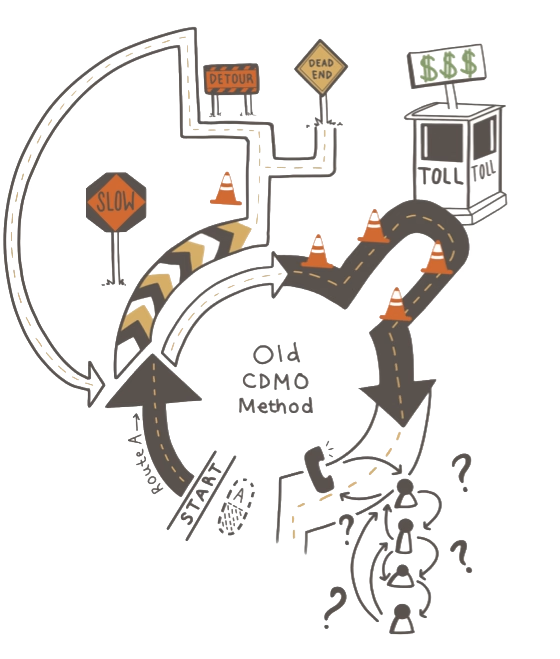
Most CDMOs are built around manufacturing. They have made large investments in plants and equipment and need to keep those plants full. Some offer development services at attractive rates mainly to win a future commercial manufacturing client.
The side effect is that development work can get less attention than it needs. A large CDMO may not explore every option to extend a product’s shelf life and may default to the methods it knows best. Its analytical methods may also fall short, which can threaten the program as it moves toward commercialization.
A development-focused partner integrates phase-appropriate formulation, stability testing, and analytical method development and execution from the start. Regulatory insight and prototype preparation are built into each stage, so future formulation, scale-up and manufacturing problems are found early. In practice, that can mean evaluating 10 ways to solubilize a compound instead of two or three. Stability studies are designed for the specific product, so the data holds up across a range of formulations.
This model also leaves room to choose among formulation approaches and dosage forms, so lead candidates are chosen for the therapeutic outcome rather than for what a plant can make. When the product is ready to scale, the partner manages tech transfer and oversees cGMP production at the selected manufacturer.
2. Will the CDMO build your CMC plan early?
CMC (chemistry, manufacturing and controls) is the body of data that shows FDA how a drug is made, tested and kept stable. A CMC plan built early is the best protection against manufacturing and regulatory problems later in development.
A development partner identifies the most suitable formulation approaches and scalable processes through careful study design and execution in the lab. This can move some cost earlier in the program. It saves more later by avoiding the delays and rework that stall programs in later phases.
CMC Pharma’s RAMP (Rapid and Agile Manufacturing of Prototypes) prepares small, non-GMP prototype batches in our lab. Those prototypes are used to evaluate feasibility, dosing, stability and efficacy in animal studies, and they generate stability and PK (pharmacokinetic) data with minimal API (active pharmaceutical ingredient). As lead candidates emerge, the process is scaled and a qualified CMO is selected for larger production, all coordinated by one partner.
3. Will choosing a CDMO now lock you into its manufacturing
technology?
Often, a CDMO is chosen before the right formulation and delivery method for the drug are known. That ties the program to whatever manufacturing technologies the CDMO happens to have.
For example, lab work may show that an API works best as a long-acting injectable, but the CDMO already chosen does not manufacture long-acting formulations. The CDMO may push a weaker formulation that fits its equipment, or the developer may have to switch providers, which costs time and money that cannot be recovered.
A better sequence is to explore a wide range of technologies and dosage forms first, identify the best formulation, delivery method and process, and then choose a CMO that can meet those requirements at scale. Development partners that operate independently of any manufacturer can recommend the best option for the drug, not the option that fits a particular plant.
Using a separate manufacturer does not mean losing end-to-end support. CMC Pharma identifies, qualifies and selects the CMO, transfers the formulation, analytical methods and processes it developed, and provides quality oversight during production.
4. Will you talk directly to the scientists doing your work?
Large CDMOs often have separate regulatory, formulation and manufacturing teams. Information can be lost between teams or on its way to the client, handoffs create errors, and extra layers stretch timelines. Some clients simply get lost among a high volume of projects.
A smaller, unified team responds faster and makes fewer handoff errors. At CMC Pharma, the scientists running the studies are in direct contact with the client, and every scope includes project management. Developers also avoid hiring separate vendors to execute studies and consultants to design and oversee them, because one partner owns the strategy, the execution and the interpretation of the data.
Full-service CDMO vs. development partner with CMO oversight
| Full-service CDMO | Development partner with CMO oversight | |
|---|---|---|
| Core business | Manufacturing capacity | Development and CMC strategy |
| Formulation options | Often limited to the CDMO’s own technologies | Chosen for the drug, across dosage forms |
| When the manufacturer is chosen | At the start of the program | After formulation and process are defined |
| GMP manufacturing | In-house | At a qualified CMO, with tech transfer and oversight |
| Who you talk to | Account and project managers across separate teams | The scientists running your studies, plus a project manager |
| Best fit | Programs with a settled formulation that need production at scale | Preclinical and early clinical programs still defining formulation and CMC strategy |
Questions to ask any CDMO or development partner
- How many formulation approaches will you evaluate, and are any limited by your own equipment?
- Are your analytical methods stability-indicating, and how will you show that to FDA?
- Can you build a phase-appropriate CMC plan toward an IND?
- If our best formulation needs a technology you do not manufacture, what happens?
- Will we own the data, methods and process knowledge, and what does tech transfer cost if we move manufacturing?
- Will we talk directly to the scientists running our studies?
Results from CMC Pharma programs
- Shelf-life extension. For a U.S. Government oral drug with a 3-month shelf life, CMC Pharma developed validated methods
and ran cGMP stability studies. FDA extended the shelf life to 14 months. - FDA deficiency response. After FDA questioned whether a drug-device combination product’s analytical methods were stability-indicating, CMC Pharma redesigned the methods through forced degradation studies and supported the client’s FDA interactions. FDA approved an 18-month shelf life.
- Two-API injectable. For a U.S. Government program combining two unstable APIs in one injectable, CMC Pharma developed new stabilization strategies and reached a multi-year shelf life.
Frequently asked questions
What is the difference between a CDMO and a CMO?
A CDMO (contract development and manufacturing organization) provides both development and manufacturing. A CMO (contract manufacturing organization) focuses on GMP production of a drug whose formulation and process are already defined.
Does a preclinical program need a CDMO?
Not always. Preclinical programs mainly need formulation, analytical and stability work and a CMC plan. GMP manufacturing can be added later through a CMO selected once the formulation is set.
Can a development partner without its own GMP plant support GMP manufacturing?
Yes. CMC Pharma selects and qualifies the contract manufacturer, transfers the formulation, methods and process it developed, and oversees GMP production on the sponsor’s behalf.
What is an alternative to a large CDMO for a small biotech?
For small-molecule and synthetic peptide programs that are still building their CMC strategy, a development partner with its own labs and vendor-neutral CMO oversight is one alternative. It lets the program choose the best formulation first and the manufacturer second.
What does CMC Pharmaceuticals do?
CMC Pharmaceuticals helps small-molecule and synthetic peptide drug developers with CMC work, from early formulation through FDA approval. Its lab in Solon, Ohio handles formulation, analytical method development and validation, ICH stability studies and RAMP prototypes. For GMP material, CMC Pharma selects and qualifies the CMO, manages tech transfer and oversees manufacturing.
Talk to our scientists about your program
Schedule a consultation to see how this approach can work for your program. Phone: 440-485-1734 | Email: info@cmcpharm.com | Contact us
Want more information on this topic? Download the full whitepaper!